

Managing small business cash flow is one of the hardest parts of running a business — not because it’s complicated, but because the warning signs are easy to miss. Revenue is growing, orders are up, and yet there’s never enough cash in the bank. Understanding the cash flow mistakes that quietly drain your business is the first step to fixing them.
Profit Is Not the Same as Cash
Here is the uncomfortable truth that catches many business owners off guard: your business can be profitable on paper and still run out of cash. In fact, cash flow problems — not lack of profit — are among the leading causes of business failure in Australia. For a deeper understanding of how your financial reports work, read what your Profit & Loss statement is really telling you.
The confusion is understandable. When you look at your Profit & Loss report at the end of the month and see a healthy bottom line, it feels like confirmation that everything is working. But your P&L shows what you’ve earned and what you’ve spent on an accrual basis — it does not show what’s actually sitting in your bank account ready to pay bills, meet payroll, or fund your next order.
This is the essential difference in the profit vs cash flow equation: profit is what you’ve earned, cash is what you can actually spend. You can be winning on the scoreboard while the patient is in cardiac arrest.
In this article, we break down the most common cash flow mistakes that quietly erode the financial health of Australian businesses — and what you can do about them.
Mistake #1: Confusing Revenue With Cash
Revenue recognition and cash collection are two entirely different events. When you invoice a client, your accounting system records the revenue. But the cash doesn’t arrive until the invoice is actually paid — which might be 30, 60, or even 90 days later.
In the meantime, you still need to pay your suppliers, your staff, and your overheads. This gap between earning revenue and collecting cash is called the cash conversion cycle — the time it takes for money spent on inputs to return as cash from customers. For many businesses, a long cash conversion cycle is the single biggest driver of cash stress.
Real-world example: A trade business wins a $180,000 commercial fit-out contract. Materials are purchased up-front ($45,000), labour costs begin immediately, and the invoice is issued 60 days later on project completion. The business is profitable — but for two months, it has funded the entire project from its own pocket. Without a cash buffer or a draw-down arrangement, this profitable job can trigger a cash crisis.
The fix is not to avoid large contracts. It’s to build progress payment schedules into your contracts, require deposits upfront, and forecast the cash timing of each project before you commit.

Mistake #2: Not Having a Cash Flow Forecast
Most business owners manage cash reactively — they check the bank balance when a bill is due, then decide whether to pay it. This approach works until it doesn’t. For guidance on keeping your financial records compliant with the ATO, including BAS timing, our step-by-step guide covers the key obligations.
A cash flow forecast — even a simple one — changes the game. Rather than reacting to a crisis, you anticipate it weeks in advance and have time to act. The Australian Government’s guide to managing cash flow is also a useful reference for foundational principles.
The most practical format is the 13-week rolling cash flow forecast. It maps every expected cash inflow (customer receipts) and cash outflow (supplier payments, wages, rent, loan repayments, BAS) on a week-by-week basis for the next 13 weeks — or approximately one quarter. A cash flow projection at this level of detail gives you the visibility to spot problems while you still have room to move.
Why 13 weeks? Thirteen weeks aligns closely with the quarterly BAS cycle, gives you enough runway to course-correct on meaningful issues, and remains short enough to be realistic. Forecasting beyond 6 months often becomes more fiction than fact.
Building a 13-week forecast does not require complex software. A well-structured spreadsheet with your opening bank balance, weekly receipts, and weekly payments will give you the visibility you need. The discipline is in updating it weekly, not building it perfectly.
Mistake #3: Overtrading — Growing Faster Than Your Cash Can Fund
Overtrading is one of the most counterintuitive ways a business can get into financial difficulty. It happens when a business takes on more work or sales volume than its working capital can support.
Consider this: to fulfil a 50% increase in orders, you may need to buy 50% more stock, take on additional staff — including meeting your Payday Super obligations from 1 July 2026 — and expand your operating capacity, all before you collect payment from new customers.
If your working capital base hasn’t grown proportionally, the business is effectively funding rapid growth from a shrinking cash pool. Growing businesses are disproportionately exposed to this risk because their cash outflows (costs of growth) tend to run ahead of their cash inflows (receipts from new revenue). This is why profitable growth can still kill a business.
The practical test is simple: before accepting a significant new contract or scaling operations, model the cash timing. Map out when cash goes out versus when it comes in. If the gap is too large relative to your cash reserves, either negotiate better payment terms with the customer, draw on a working capital facility, or phase the expansion.
Mistake #4: No Minimum Cash Buffer
Every business should maintain a minimum cash reserve — a buffer that covers a defined number of weeks of operating expenses regardless of what else is happening. Think of it as your financial immune system. Ensuring accurate payroll processing to protect your cash position is one key discipline that prevents cash buffer erosion from payroll errors.
Without a buffer, any disruption — a large customer paying late, an unexpected equipment repair, a seasonal slowdown, or a Fair Work wage payment obligation falling at an inconvenient time — can immediately threaten your ability to meet obligations. With a buffer, you have time to respond rather than react.
How much is enough?
- Recurring revenue businesses (monthly retainers, subscriptions): 4–6 weeks of operating expenses
- Project-based businesses (trades, construction, professional services): 8–12 weeks of operating expenses
- Seasonal businesses: model your worst cash month and ensure you can cover it from reserves
Setting a minimum cash buffer is not about hoarding cash. It’s about giving your business the breathing room to make decisions from a position of strength rather than desperation. Business owners who are constantly cash-stressed tend to make worse decisions — they take on the wrong clients, accept poor payment terms, and miss growth opportunities because they can’t fund them.
Mistake #5: Slow Debtor Collection and Poor Accounts Receivable Management
Outstanding invoices are one of the most common — and most fixable — causes of cash flow problems in businesses of all sizes. Every dollar sitting in accounts receivable is a dollar that could be working in your business. Our bookkeeping services include regular accounts receivable monitoring so nothing slips through the gaps.
The problem often starts with the billing process itself. Many businesses issue invoices at the end of a project or at the end of the month, when they could be issuing them on completion of each deliverable or milestone. The later you invoice, the later you get paid — it’s that simple.
Once an invoice is issued, the collection process matters as much as the terms. Research consistently shows that the longer an invoice remains unpaid, the lower the probability of collection. An invoice that is 90 days overdue is significantly harder to collect than one that is 30 days overdue.
Practical steps to improve debtor collection:
1. Invoice immediately on completion — not at month end.
2. Set clear payment terms upfront (Net 14 or Net 7 where possible, not Net 30+).
3. Send automated payment reminders at day 7 and day 14 overdue.
4. Follow up personally at day 21 with a phone call, not just an email.
5. Consider offering a small prompt payment discount (1–2%) for payment within 7 days.
Your Accounts Receivable Report Is Your Starting Point
In Xero, the Aged Receivables report gives you a real-time view of every outstanding invoice, sorted by how long it has been outstanding. Review it weekly — not monthly — and know exactly which invoices are overdue, by how much, and who the debtor is. Strong accounts receivable management is one of the highest-leverage activities available to any business owner. Most businesses that improve their collection process see a meaningful improvement in cash position within 30 to 60 days — without changing their revenue by a single dollar.

Mistake #6: Ignoring the Other Side — Your Supplier Payment Terms
Most businesses focus exclusively on collecting cash faster, but the other lever is equally powerful: extending the time before cash goes out. Your supplier payment terms are a negotiable asset that most business owners never fully use.
If you are currently paying suppliers on 7-day or 14-day terms, and your customers are paying you on 30-day terms, you are structurally funding a cash gap every single month. Closing that gap — or reversing it — is a core principle of working capital management, and it can transform your cash position without changing your revenue by a single dollar.
The negotiation most owners avoid: Contact your top 5 suppliers and ask directly whether extended payment terms are available — Net 30 or Net 45 instead of Net 7 or Net 14. Longer-standing relationships and consistent payment history give you leverage. You may be surprised how often suppliers will accommodate the request simply because you asked.
The objective is not to delay payments indefinitely or damage supplier relationships. It’s to align your cash outflows more closely with your cash inflows, so that the natural rhythm of your business doesn’t require you to fund a structural gap from your own reserves each month.
Mistake #7: Mixing Business and Personal Finances
This one is foundational, and yet it remains remarkably common among businesses under $2M in turnover. When personal and business finances are mixed, you lose clarity on both. Our guide to common BAS lodgement mistakes covers how mixed finances create GST and compliance errors that trigger ATO scrutiny.
Beyond the measurement problem, mixed finances create material tax compliance risk. The ATO’s cash flow record keeping obligations make clear that businesses are expected to maintain separate, accurate financial records.
The fix is straightforward: maintain a dedicated business bank account, a dedicated business credit card, and pay yourself a defined salary or owner’s draw. Every business transaction flows through the business account. Every personal transaction flows through your personal account. The separation is clean, the reporting is accurate, and your tax agent’s life — and yours — becomes considerably easier.
Mistake #8: Misreading the Current Ratio
The Current Ratio is one of the most useful — and most ignored — financial metrics available to business owners. It measures your business’s short-term liquidity: specifically, its ability to meet obligations that fall due within the next 12 months using assets that will be converted to cash within the same period.
The formula: Current Assets ÷ Current Liabilities
A Current Ratio above 2.0 is generally considered healthy — it means you hold $2 in liquid assets for every $1 of short-term obligation. A ratio below 1.0 means your short-term liabilities exceed your current assets, which is a significant early warning indicator.
To put it in context: a business generating strong operating cash flow can still carry a weak Current Ratio if it has been funding growth through short-term debt. Conversely, a business with a healthy Current Ratio but poor operating cash flow may be sitting on assets it cannot easily convert. Both measures matter — and neither tells the full story alone.
The critical insight is that many business owners only discover a deteriorating Current Ratio during their annual tax preparation — by which point, a ratio of 0.7 or 0.8 may already represent an acute cash crisis. Checking this number quarterly, as part of a regular financial review, gives you time to act while options are still available.
Quick Reference: 8 Cash Flow Mistakes at a Glance
| Cash Flow Mistake | Why It’s Dangerous |
|---|---|
| Confusing revenue with cash | Profitable businesses fail when the cash conversion cycle creates timing misalignment |
| No cash flow forecast | Problems surface too late to act — reactive management compounds the crisis |
| Overtrading | Rapid growth funded by shrinking working capital creates structural insolvency risk |
| No cash buffer | Any disruption becomes immediately existential without reserves |
| Poor accounts receivable management | Outstanding invoices represent real money not working in your business |
| Ignoring supplier payment terms | Paying suppliers faster than you collect creates a structural cash gap |
| Mixed personal/business finances | Contaminated data, compliance risk, and inability to measure true performance |
| Ignoring the Current Ratio | A deteriorating ratio is often the earliest measurable signal of cash stress |
Your 30-Day Action Plan to Improve Cash Flow
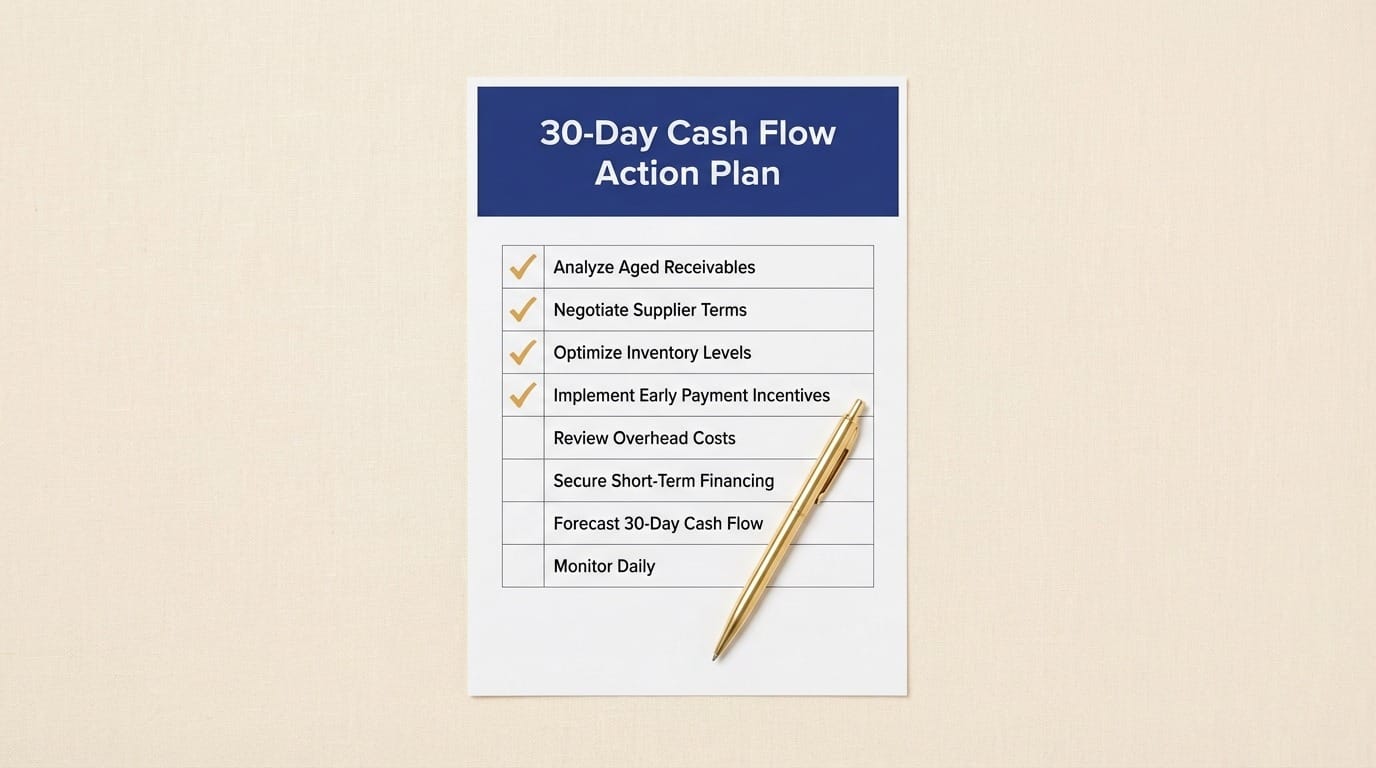
Identifying cash flow mistakes is only useful if it drives action. Here is a practical 30-day plan to improve cash flow in your business immediately, without specialist software or an accounting degree.
| Timeframe | Action |
|---|---|
| This week | Pull your last 3 months of bank statements and map actual cash inflows vs outflows by week |
| This week | Identify your 3 largest customers — when did they last pay and when is the next payment due? |
| Week 2 | Review your customer payment terms and send overdue invoice reminders |
| Week 2 | Contact your top 5 suppliers and request extended payment terms — Net 30 or Net 45 where possible |
| Week 2 | Calculate your Current Ratio (Current Assets ÷ Current Liabilities) — target above 1.5 |
| Week 3 | Build a simple 13-week cash flow forecast in a spreadsheet |
| Week 3 | Set a minimum cash buffer equal to 6–8 weeks of average operating expenses |
| Week 4 | Review your top 3 expenses — are any growing faster than your revenue? |
| Ongoing | Review cash position weekly, not monthly — problems surface earlier |