


At some point in the life of every growing business, the finance function stops being something the owner can manage on a Sunday afternoon.
Bookkeeping, payroll, bank reconciliations, BAS lodgements, chasing overdue invoices, and trying to make sense of a monthly report that’s three weeks late — these tasks don’t disappear, and they don’t get simpler as the business grows. They multiply. And the hours they consume are hours that aren’t going toward winning new clients, managing your team, or making the decisions that actually move the business forward.
The small business hiring decision around the finance function is one of the most financially consequential choices a growing business will make. And most get it wrong — not by making a bad decision, but by defaulting to the most familiar one rather than the most intelligent one.
The options available today look very different from what they did even three years ago. You can hire. You can outsource. You can implement AI automation tools that handle significant portions of the mechanical work. Or — most powerfully — you can combine all three in the right sequence. The businesses getting this right are not just building a more efficient finance function today. They are building one that keeps improving — compounding efficiency gains over time in a way that a static, manually-resourced finance function simply cannot match.
This guide gives you a practical framework for the hire or outsource small business decision — with a clear-eyed look at where AI and automation fit into the picture. We’ll walk through the true cost of each option, the questions you need to answer before committing, and a realistic assessment of what AI bookkeeping tools in Australia can and cannot do.
Why This Decision Matters More Than You Think

Most business owners underestimate what it actually costs to resource the finance function — in any configuration.
If you’re hiring, the salary figure on the job ad is the starting point, not the full picture. By the time you add superannuation, leave entitlements, workers’ compensation, and the hidden cost of onboarding and management time, the true cost of hiring an employee in Australia is typically 26–29% above their base salary. A $65,000 bookkeeper or finance administrator costs closer to $82,000–$84,000 per year in reality.
And that’s before you factor in the specific cost of a bad finance hire. Unlike a poor hire in sales or operations — where the damage is visible and containable — a finance hire who lacks competency can create problems that compound silently: BAS lodged with errors, payroll miscalculations that create ATO exposure, reconciliations that look clean but mask cash flow issues. The cost of unwinding these problems often exceeds the cost of the hire itself. For a practical look at the compliance risks that flow from poor financial management, see our guide to common BAS lodgement mistakes that create ATO exposure.
If you’re outsourcing bookkeeping for your business, the invoice is transparent but the total cost isn’t. Transition costs, quality control time, and the gap between what a standard bookkeeping firm delivers and what a modern AI-enabled firm delivers are all factors that don’t appear on the retainer agreement.
If you’re considering AI automation tools to automate versus hire, the subscription cost is low — but the implementation time, learning curve, and ongoing oversight required are real costs that most owners discover after the fact.
The True Cost of Hiring a Finance Resource
Base Cost Components
Before you post a job ad, build a full cost picture. Here’s how to estimate the true annual cost of hiring an employee in Australia for a bookkeeper or finance administrator role, using $65,000 as a base salary example:
Base salary: $65,000 — a reasonable benchmark for a competent part-time or full-time bookkeeper or finance administrator in most Australian capital cities.
Superannuation (12%): Add $7,800. Compulsory from FY2026 onwards under the ATO superannuation guarantee obligations — non-negotiable. For a full breakdown of what changes from 1 July 2026, see our Payday Super 2026 complete guide.
Annual leave (4 weeks): Under the National Employment Standards on leave entitlements, employees accrue 20 days of paid annual leave per year. On a $65,000 salary, this represents approximately $5,000 in leave liability each year, regardless of whether it’s taken.
Annual leave loading (17.5%): Many awards and enterprise agreements require an additional 17.5% loading when annual leave is taken. On 4 weeks’ pay, that’s approximately $870.
Personal/carer’s leave (10 days): Employees are entitled to 10 days of paid personal leave per year under the NES — approximately $2,500 in accrued liability. Often overlooked in cost modelling because it only crystallises when taken, but it’s a real financial obligation.
Workers’ compensation insurance: Varies by state and industry, but typically 1–3% of wages. Budget $1,000–$2,000.
Long Service Leave (LSL): Often overlooked entirely in early-stage cost modelling, but worth factoring into your long-term employment planning. LSL entitles employees to an extended period of paid leave after a qualifying period of continuous employment — typically 7 to 10 years depending on the state or territory. The key point: the liability accrues from day one of employment, even if it takes years to crystallise. Each state and territory has its own legislation governing LSL — the entitlement period, rate of accrual, and portability conditions differ across NSW, Victoria, Queensland, Western Australia, South Australia, Tasmania, the ACT, and the Northern Territory. If you’re planning to employ someone long-term, factor a LSL provision into your true cost modelling.
Running the numbers, the true annual cash cost of our $65,000 example sits around $82,000–$84,000 — a 26–29% premium over the headline salary figure. LSL accrual adds a further long-term liability that doesn’t appear in the annual cash cost but is real nonetheless.
The planning rule: always model at 1.3× base salary as your minimum annual cash cost.
| Cost Component | Amount (est.) | % of Base |
|---|---|---|
| Base Salary | $65,000 | 100% |
| Superannuation (12%) | $7,800 | 12.0% |
| Annual Leave (4 weeks) | $5,000 | 7.7% |
| Annual Leave Loading (17.5%) | $870 | 1.3% |
| Personal/Carer’s Leave (10 days) | $2,500 | 3.8% |
| Workers’ Comp Insurance | $1,500 | 2.3% |
| Long Service Leave (accrual) | Variable by state | Note only |
| Total Estimated Annual Cash Cost | ~$82,670 | ~127% |
A Note on AI-Proficient Finance Hires
Not all bookkeepers and finance administrators are equal in today’s market. Candidates with genuine proficiency in AI bookkeeping tools — Xero’s automation features, Dext for document processing, automated reporting platforms — typically command a salary premium of 15–25% above a standard hire. But their effective output can be significantly higher: what takes a standard bookkeeper 20 hours per week may take an AI-proficient hire 10–12 hours to the same or better standard.
What makes the difference isn’t just knowing how to use the tools that exist today. The most valuable AI-proficient hires approach the finance function with a continuous improvement mindset — always asking whether a new tool, a better rule configuration, or a smarter workflow could reduce friction further. When you hire for this mindset, you’re not just buying more capacity today — you’re hiring someone who will keep finding ways to need fewer hours tomorrow. The premium at hire is not a fixed cost for a fixed output — it’s an investment in a function that gets better over time.
The True Cost of Outsourcing the Finance Function

Base Cost Components
Outsourcing costs are generally more transparent — you receive an invoice and pay it. But there are hidden costs that don’t show up on the retainer agreement.
Firm or contractor rates: Specialist bookkeeping firms and contractors typically charge monthly retainers or hourly rates that appear higher than an equivalent employee’s hourly wage. This is expected — the provider carries their own overhead, super, insurance, and software costs. What you’re paying for is output, not presence.
Transition costs: Every time you change providers or eventually bring the function in-house, there is a cost in time, documentation, and institutional knowledge transfer. A firm that has built familiarity with your chart of accounts, your clients, and your transaction patterns takes time to replace.
Quality control: Without the same day-to-day visibility you have with an employee, outsourced work requires oversight. You’ll spend management time reviewing output — particularly in the early months of a new engagement — and any errors still need to be caught and corrected.
Contract minimums: Many bookkeeping firms require minimum monthly commitments regardless of volume, which reduces the variable cost flexibility that makes outsourcing attractive in quieter periods.
Despite these factors, outsourcing the finance function remains the lower-risk option for most growing businesses — particularly when volume is still building, the work is specialist and compliance-driven, and you want to avoid the fixed cost commitment of employment before revenue growth is proven.
A Note on AI-Enabled Bookkeeping Firms
The outsource bookkeeping market is not homogeneous. Firms that have embedded AI tools into their workflow — automated reconciliation, Dext or Hubdoc for document capture, exception-based review rather than line-by-line processing — deliver materially higher accuracy and volume capacity than firms still operating on manual processes.
But beyond which off-the-shelf tools a firm uses, the most forward-thinking providers have gone a step further: they have invested in building their own proprietary AI-powered software. This is not a subscription any client can replicate by signing up to a platform — it is the result of significant internal development time, cost, and iteration, creating tools that are unique to that firm and unavailable anywhere else. These proprietary systems can deliver business functions — custom reporting dashboards, automated exception workflows, client-specific integrations — that simply don’t exist in the general market. When evaluating an outsourced provider, it’s worth asking not just what platforms they use, but whether they have developed any tools of their own and what client problems those tools are designed to solve.
The more important distinction is whether a firm has the mindset to keep improving their workflow as AI capabilities evolve. When you engage a firm that thinks this way, your finance function benefits from their ongoing investment in better tooling without you bearing the management overhead of staying current yourself. In effect, outsourcing to an AI-enabled firm means outsourcing the process improvement function as well — their efficiency gains become your efficiency gains.
The Cost of AI Tools and Automation
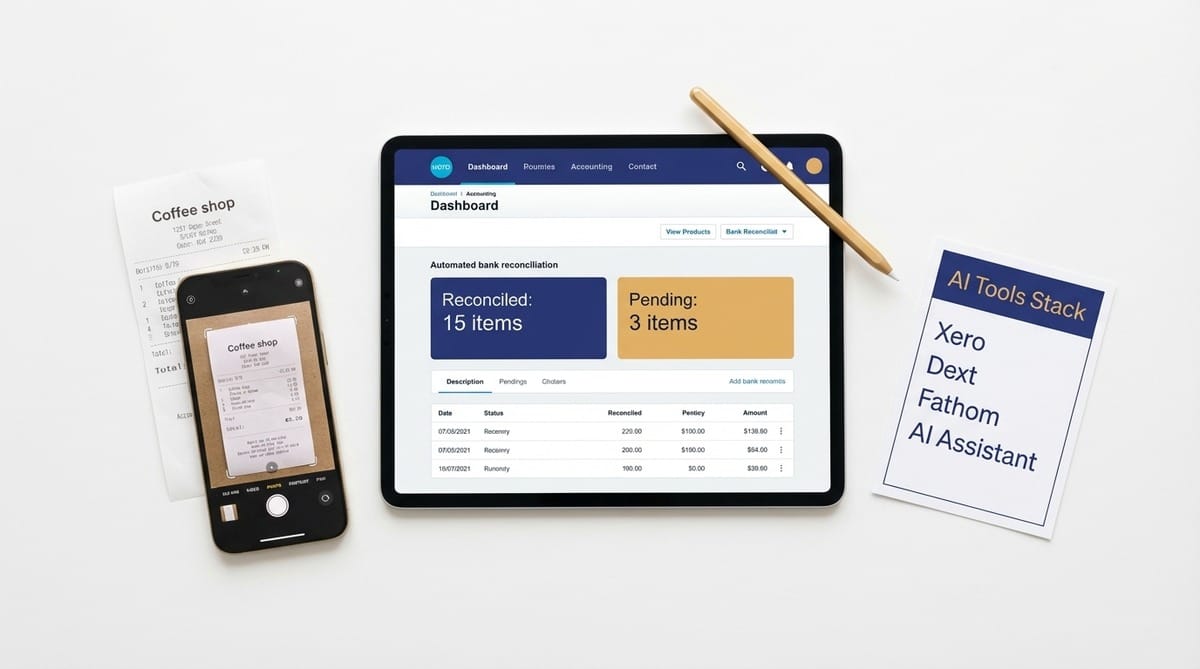
AI automation tools for small business deserve their own cost analysis — low upfront cost and immediate capacity gains, but with hidden costs that are easy to underestimate.
What AI Bookkeeping Tools in Australia Actually Cost
The subscription cost of a well-equipped AI-assisted finance stack is modest:
- Xero or MYOB (core accounting platform with automated bank matching and payroll): $50–$120/month
- Dext or Hubdoc (receipt and invoice capture with automatic coding): $30–$80/month
- Fathom, Spotlight Reporting, or Figured (AI-assisted management reporting): $40–$150/month
- General AI tools (drafting, summarising, flagging anomalies): $20–$30/month
A reasonably well-equipped AI bookkeeping Australia tech stack sits in the $150–$300/month range — a fraction of the cost of either hiring or outsourcing.
What’s Hidden in the Cost
The subscription is the easy part. The real cost of implementing AI automation tools is in three areas that most owners underestimate:
Connecting your tools so they talk to each other: The most time-consuming part of AI implementation isn’t installing software — it’s getting your existing systems to share information automatically. This means setting up the link between your job management software and your accounting platform so that invoices flow through without being re-entered, connecting your payroll system so that wage data feeds directly into your reconciliation, and mapping how data moves between each tool at each step. Getting this right upfront — before you trust the outputs — typically takes several weeks of configuration and testing. Our guide to year-end Single Touch Payroll finalisation gives a useful picture of how interconnected payroll and reporting obligations are in practice.
Setting the rules that tell the system how to categorise your transactions: AI tools work by learning patterns from your instructions. You need to define how each type of transaction should be handled — which expenses go to which account, how to treat mixed-purpose costs, what happens when an unusual item comes through. Until those rules are properly configured for your specific business, the system will make errors that a human still needs to catch and correct. This isn’t a one-off task — rules need periodic review as your business changes.
Ongoing oversight once the system is running: AI tools require active monitoring. Rules misfire. Connections between systems drop out. Exceptions accumulate in queues that need human review. Research suggests finance professionals spend around 62% of their time on compliance and transactional tasks that automation can reduce — but only when the tooling is properly maintained. Without that maintenance, the gains erode.
The critical limitation: AI tools alone, without a skilled person managing and interpreting them, is the weakest of the three configurations. An AI platform that produces a clean reconciliation report doesn’t tell you that your debtors are trending the wrong way or that your margin is compressing in one revenue stream. That interpretation requires a human. AI reduces the volume of mechanical work — it does not replace the judgement layer that sits above it.
AI in Your Finance Function: The Strategic Picture

This section is not about what AI tools can do — that’s covered above. It’s about what separates businesses that use AI well from those that merely install it.
The Power of People Who Know How to Use AI
The most powerful configuration in the finance function right now is not AI replacing people. It is AI-skilled people deploying the right tools — with human intelligence applied at the layer where it matters most: review, interpretation, judgement, and communication. The question isn’t whether to hire or automate — it’s how to combine them effectively.
The best AI-skilled finance professionals go beyond proficient use of existing tools. They actively improve the system around them. They bring new tools to your attention, flag where your current setup has gaps, and approach the finance function as something to be continuously optimised rather than simply maintained. They ask: is there a better rule configuration that would reduce the exception queue? Is there an integration between two systems that would eliminate a manual data transfer? Is there a reporting template that would save the owner 30 minutes of interpretation each month?
This mindset is what makes an AI-skilled hire or AI-enabled firm a strategic asset rather than just a more efficient resource. And it’s what separates a finance function that compounds in value over time from one that simply runs at a lower cost. Tools don’t iterate on themselves — the person managing them does.
Where Human Input Remains Essential
For all the productivity gains AI delivers, there are areas where human input is irreplaceable — and over-relying on AI here is where errors and compliance risks accumulate.
Compliance and regulatory interpretation: Australian bookkeeping involves GST rules, BAS lodgement compliance requirements, payroll, and ATO obligations that change over time. AI tools do not interpret legislation or apply professional judgement to compliance questions. For anything touching regulatory obligations, human oversight is not optional.
Review and interpretation of outputs: AI can reconcile. It cannot tell you what the reconciliation means for your business. A human needs to read the output, question anomalies, and translate numbers into decisions. For a practical framework on understanding what your P&L is really telling you, see our financial literacy guide.
Judgement calls on ambiguous transactions: Inter-company transfers, mixed-purpose expenses, unusual revenue items — these require someone who understands your business well enough to code them correctly and consistently.
Identifying what patterns mean: A report showing margin compression, rising debtor days, or deteriorating cash conversion is only useful if someone interprets it and acts on it. AI can surface the pattern. It cannot formulate the response.
Client-facing communication: For businesses where finance intersects with client relationships — construction progress claims, professional services billing, healthcare bulk billing — the communication layer requires human judgement that AI cannot replicate.
Security and Data Considerations
Where your data lives: Most AI-powered finance tools are cloud-based, meaning your financial data sits on third-party servers. Understanding where that data is stored (Australian vs offshore), who has access to it, and the provider’s breach notification policies is basic governance. The Australian Privacy Act and cloud data obligations apply to how your financial data is stored and handled — worth reviewing if you’re moving to a cloud-first finance stack.
Access controls: If you’re using an outsourced firm that also uses AI tools, you are sharing data access at multiple levels. Review permissions periodically and revoke access promptly when engagements end.
Accuracy risk from over-reliance: BAS lodgements, payroll tax, and superannuation guarantee obligations carry penalties for errors — regardless of whether those errors were made by a human or an AI tool. A structured human review process is not optional.
Vendor risk: AI tools change. Platforms get acquired. Features are deprecated. Build your finance workflow around sound processes first, with AI tools accelerating them — not the other way around.
Decision Matrix: Hire, Outsource, or Automate Your Finance Function

The when to hire versus outsource decision maps closely to where your business sits in its revenue journey. Start at your current revenue range and work forward — each configuration reflects a specific combination of cost, output capacity, and improvement trajectory suited to that stage.
Option 1 — Standard Outsourced Bookkeeping Firm (Under $500K Revenue)
For businesses in the early stages — under $500K in revenue, straightforward transaction types, minimal reporting needs — a standard bookkeeping firm at a modest retainer is a sensible starting point. Your transaction volume doesn’t yet justify the cost of AI-enabled services or in-house headcount, and your compliance requirements are manageable with a competent manual operator.
The risk is staying here beyond the point where your needs have outgrown the capability. A standard firm’s output is static — it looks the same in year two as it did in month one. As soon as your volume grows or your reporting needs become more complex, you’ll feel the ceiling.
Option 2 — AI-Enabled Bookkeeping and Advisory Firm ($500K–$5M Revenue)
This is the strongest outsource bookkeeping configuration for most businesses in the growth phase. An AI-enabled firm brings its own technology stack — automated reconciliation, document capture, exception-based review — and delivers higher quality output at a comparable or lower per-unit cost than a manual firm handling the same volume.
More importantly, an AI-enabled firm with a continuous improvement culture means your finance function benefits from their ongoing investment in better tooling without you managing it. Their efficiency gains become your efficiency gains — and the advantage widens over time rather than narrowing.
What to ask when evaluating an outsourced provider:
- What AI or automation tools do you use in your reconciliation and data processing workflow?
- Have you developed any proprietary AI-powered tools — and what client problems do they solve?
- How do you manage exceptions flagged by automated systems — who reviews them and at what frequency?
- Who reviews AI-generated outputs before they reach the client?
- Do you proactively identify workflow improvements for clients over the course of an engagement?
A firm that can’t answer these questions clearly is almost certainly still operating on a manual model.
Option 3 — Standard Finance Hire (Businesses Above $5M, High Transaction Volume)
A standard bookkeeper or finance administrator — without specific AI tool proficiency — makes sense when transaction volume is high enough to justify full-time or near-full-time employment, the role is deeply embedded in day-to-day operations, and the work requires the continuity and institutional knowledge that an outsourced provider can’t easily deliver.
At this revenue level, the volume and operational complexity often justify the fixed cost of employment. The processes are well-defined, the work is consistent, and embedded knowledge genuinely adds value. The risk to be aware of: a standard hire without AI proficiency will hit capacity constraints as the business continues to grow, because their output scales with hours, not with tooling.
Option 4 — AI-Proficient Finance Hire (Any Stage Where Efficiency and Growth Are the Priority)
This is the hire worth investing in for any business where scalability, accuracy, and long-term efficiency matter more than minimising upfront salary cost. An AI-proficient bookkeeper or finance administrator commands a 15–25% salary premium — but their effective output capacity is significantly higher, their error rate lower, and their ability to build and maintain an automated finance function means you’re not rehiring for the same problem in two years.
Critically, the value of this hire increases over time. As they deepen their configuration of your systems, identify further automation opportunities, and refine the workflow around your specific business, the premium you paid at hire compounds into an ongoing efficiency advantage. You are not paying more for the same thing — you are paying for a finance function that keeps getting better.
The Three-Layer Hybrid Model
For most growing businesses, the optimal answer to the hire or outsource question isn’t one option in isolation. It’s a sequenced combination of all three — treated as a living system rather than a set-and-forget decision.
Layer 1 — Implement AI finance tooling first. Before hiring or outsourcing, ensure your core platform (Xero or MYOB) is properly configured with bank feeds, automated reconciliation rules, and payroll automation. Add document capture (Dext or Hubdoc) if you have meaningful invoice and receipt volume. This layer costs $150–$300/month and can reduce your mechanical admin burden by 40–60% before you’ve committed to any headcount.
Layer 2 — Outsource to an AI-enabled firm. What remains after tooling is implemented is a smaller, better-defined scope of work — exception management, compliance lodgements, management reporting, financial oversight. An AI-enabled firm handles this at a lower cost than hiring, with the flexibility to scale as your business needs change.
Layer 3 — Hire AI-skilled in-house staff when justified. Once your revenue and transaction volume reach a level where the outsourcing retainer approaches the cost of an in-house hire, and your reporting complexity warrants embedded expertise, an AI-proficient in-house hire becomes the right move. At that point you have real data — actual transaction volumes, actual hours consumed, actual reporting requirements — to hire for a well-defined role rather than guessing.
The three-layer model is not a one-time decision. Each layer should be periodically reviewed: is the tooling still optimal? Is the outsourced firm staying current with their workflow? Is the in-house hire continuing to drive improvement? The businesses that treat this as a living system are the ones that compound the advantage over time.
| Standard Outsource (Under $500K) | AI-Enabled Outsource ($500K–$5M) | Standard Hire (Above $5M) | AI-Proficient Hire (Any Stage, Growth Focus) | |
|---|---|---|---|---|
| Best for | Early-stage, simple compliance needs | Growth-phase businesses building efficient finance operations | High-volume businesses needing embedded, full-time expertise | Any business where scalability and long-term efficiency are the priority |
| Monthly cost | Low–moderate retainer | Moderate retainer, lower per-unit cost | ~$6,900/month (true cost of $65K role) | ~$8,000–$8,600/month (true cost with AI premium) |
| Output capacity | Standard, manual | Higher, scales with AI tooling | Standard, scales with hours | Significantly higher, scales with tooling |
| Improvement trajectory | Static | Compounds over time | Static | Compounds over time |
| Key risk | Outgrows capability quickly | Vendor dependency | Capacity ceiling as business grows | Higher salary commitment upfront |
A Practical Example: The $1.8M Trades Business

To make this concrete, we’ll use the finance function of a plumbing business — a scenario that reflects the situation of thousands of Australian trade and construction businesses at the $1M–$3M revenue range.
Sarah runs a plumbing business in Western Sydney turning over $1.8 million per year. She has three plumbers on staff, and she handles all the financial administration herself — bookkeeping, payroll, bank reconciliations, BAS lodgements, and chasing overdue invoices. The financial admin consumes 15–18 hours a week — hours she’s not spending quoting new jobs, following up referrals, or building relationships with commercial clients.
Option A — Hire a part-time bookkeeper with AI tool proficiency:
Sarah hires a part-time bookkeeper at $38/hour, expecting 20 hours per week. Because this person is genuinely proficient with Xero automation, Dext for receipt processing, and automated payroll workflows, the actual hours required reduce to 10–12 hours per week once the systems are properly configured. The true annual cost including super, annual leave, and personal leave runs approximately $30,000–$35,000 at the reduced hours.
At the six-month mark, the bookkeeper identifies two further automation opportunities: automated payment reminders that reduce debtor days without Sarah lifting a finger, and a one-page weekly cash position report generated automatically from Xero. The finance function keeps improving after the hire, not just at the point of it.
Option B — Outsource to a standard bookkeeping firm:
A local firm handles her reconciliations, payroll, and BAS for a retainer of $1,600 per month — $19,200 per year. No super, no leave liability. But the firm operates largely manually, and the monthly report Sarah receives is a basic P&L with no commentary or insight. As her transaction volume grows, the retainer increases with it. The service looks the same in year two as it did in month one.
Option C — Outsource to an AI-enabled bookkeeping and advisory firm:
A specialist firm with a modern AI bookkeeping Australia tech stack handles the same scope — reconciliations, payroll, BAS, monthly reporting — for $2,000 per month ($24,000 per year). Dext captures and codes her receipts automatically. Reconciliations are exception-based rather than line-by-line. The monthly management report includes gross margin analysis, debtor ageing, and a brief commentary on what the numbers mean for her business. Sarah spends 30 minutes reviewing it each month rather than trying to interpret raw data herself.
At the six-month mark, the firm proactively identifies a further improvement: integrating Sarah’s job management software with Xero to eliminate manual job costing entry — saving a further three hours per week.
The cost difference between Option B and Option C is $400 per month. For that $400, Sarah gets automated receipt processing, faster reconciliations, management reports she can actually use, and a firm that keeps finding ways to improve her finance function.
The more important number across all three options is what Sarah does with the time she gets back. Redirecting even 8–10 hours per week to business development could realistically add $150,000–$200,000 in annual revenue at her current job values.
Sarah chooses Option C. Revenue grows to $2.3 million within twelve months. At that point, her advisory firm recommends that the transaction volume and reporting complexity now justify considering an AI-proficient in-house hire. Sarah has twelve months of real data to define the role and hire with confidence.
This is the three-layer model in practice: implement the tooling, outsource to a firm that keeps improving, and hire when the numbers clearly justify it.
How Your Financials Should Inform the Timing
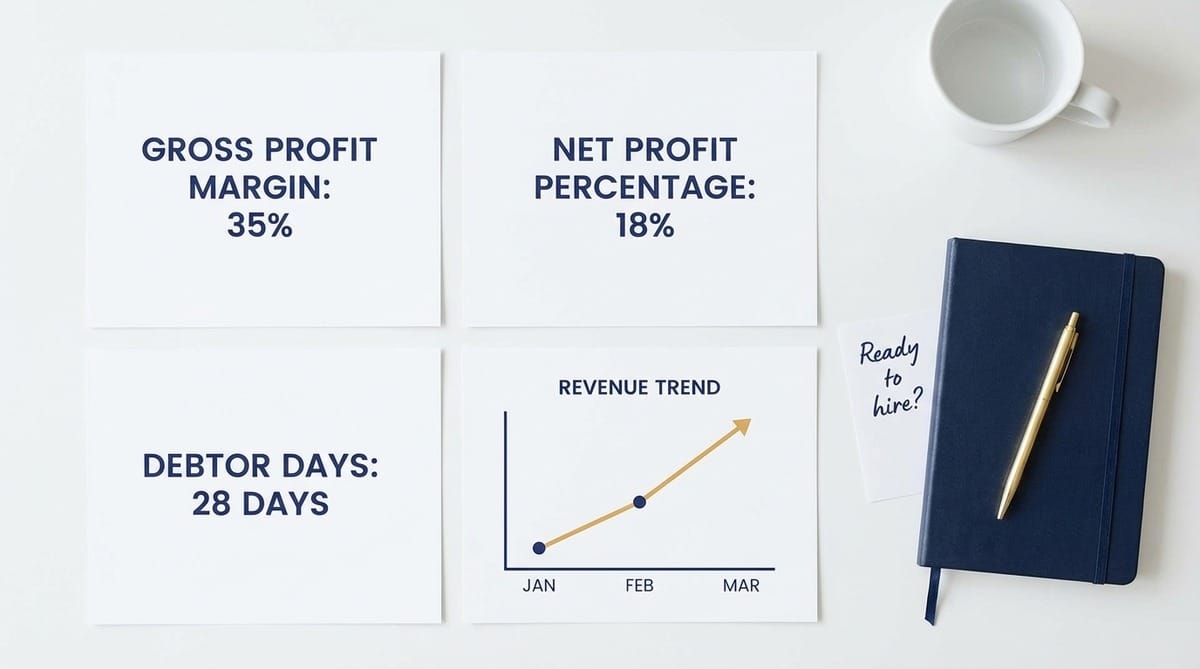
Look for these four indicators in your monthly financials before committing to any resourcing decision:
Gross profit margin is stable or improving. If your margin is shrinking, adding cost won’t help. Understand the compression first — then make a resourcing decision. For a practical guide to reading your margin, see what your gross profit margin is telling you about your business. You can also calculate your gross margin instantly using our free gross profit calculator.
Net profit is consistently above 10%. This gives you buffer. Operating at 4–5% net margin means any new fixed cost can quickly push you into loss if revenue softens.
Debtor days are under control. A growing debtors ledger means cash inflow is lagging revenue. Adding cost into a cash-tight situation is high risk regardless of how well-reasoned the decision is.
Revenue has grown for at least three consecutive months. One good month doesn’t justify a structural cost increase. Three consecutive months of growth is a more reliable signal that the investment will be supported by ongoing revenue.
If all four conditions are met, you’re in a strong position to add cost confidently. If any are uncertain, resolve them first — or start with the lowest-commitment option (AI tooling) and reassess once the financial indicators align. For a broader look at financial management discipline, see our guide to tips for better financial management.
Conclusion
The hire or outsource decision has never had more options — or more complexity. The businesses getting it right today are not the ones spending the most, or the ones holding out against AI, or the ones defaulting to whatever they did three years ago. They are the ones applying a clear framework: understanding the true cost of each option, asking the right questions about output and improvement trajectory, and sequencing their choices intelligently.
AI automation tools reduce the mechanical burden. AI-skilled people deploy those tools with the judgement and oversight that produces reliable, useful financial information. An AI-enabled outsourced firm or a proficient in-house hire doesn’t just manage your compliance — they give you the financial visibility to make better decisions about your business.
But the real advantage isn’t the efficiency gain at the point of implementation. It’s the ongoing improvement trajectory that a static, manually-resourced finance function simply cannot match. A standard bookkeeper working harder with the same tools will always be outpaced by an AI-skilled counterpart who keeps finding the next layer of efficiency to unlock. Over two to three years, that gap compounds into a structural advantage — lower cost per transaction, better financial visibility, and an owner who is spending their time on growth rather than administration.
That is exactly what the finance function should be doing for a growing business: not just recording what happened, but helping you understand what it means, what to do about it, and how to build a more efficient operation around it.
If you’d like to understand how a Virtual CFO service supports your financial decision-making without the cost of a full-time hire, we’d be glad to walk you through what that looks like for a business at your stage.