

From 1 July, you’ll need an extra $3,600 (or more) available every pay run that you didn’t need before. Same annual cost—completely different cash flow. Here’s how to prepare without the scramble.
This isn’t just a compliance tweak. It’s a fundamental change to how cash flows through your business. That quarterly buffer you’ve been using? Gone. The free ATO clearing house? Closing. And the penalties for getting it wrong are steeper than before.
Yes, this is more admin. Yes, it affects your cash flow. But here’s the thing—if you understand what’s changing and prepare now, the transition can be painless. Wait until June and you’ll be scrambling.
What’s Actually Changing?

Let’s cut through the jargon.
Right now: You pay super quarterly. The July-September quarter isn’t due until 28 October. That gives you nearly four months of breathing room.
From 1 July 2026: Super is due with every pay run. If you pay fortnightly, super is fortnightly. Weekly payroll means weekly super. And the money needs to land in your employees’ super funds within 7 business days of payday. (Yes, really—7 business days, not calendar days.)
The ATO estimated $3.6 billion in super went unpaid in 2020-21. This reform is designed to close that gap by making super visible in real-time. Employees can check their contributions after each payday instead of waiting months to discover something’s missing. For more details, visit the ATO’s Payday Super page.
The legislation passed in November 2025. This is happening.
What stays the same?
The rate is still 12%. The same employees are eligible. Your total annual super obligation doesn’t change—just when you pay it.
What Happens to Your Cash Flow Buffer?

Let’s be honest: many small businesses have used the quarterly super timeline as an informal cash flow buffer. Revenue comes in, wages go out, and there’s up to three months before super is due. That breathing room has helped plenty of businesses through tight patches.
That buffer disappears on 1 July 2026.
The Numbers Side-by-Side
Example: A business with $60,000 monthly payroll (12% SG = $7,200 monthly super)
| Current Quarterly System | Payday Super (Fortnightly) |
|---|---|
| July: Pay wages only August: Pay wages only September: Pay wages only 28 October: Pay $21,600 super | Pay Period 1: Wages + $3,600 super Pay Period 2: Wages + $3,600 super Pay Period 3: Wages + $3,600 super Pay Period 4: Wages + $3,600 super Pay Period 5: Wages + $3,600 super Pay Period 6: Wages + $3,600 super |
| Total: 1 payment of $21,600 | Total: 6 payments of $3,600 = $21,600 |
The total is identical. But under the current system, you have use of that $21,600 for up to three months. Under Payday Super, it leaves your account with each pay run.
What This Actually Looks Like: Sarah’s Café
Sarah runs a beachside café on the NSW South Coast. Her business is seasonal—packed from November to February, quiet from May to August.
Summer: $80,000 monthly payroll, strong cash flow, tourists everywhere.
Winter: $30,000 monthly payroll, locals only, margins are tight.
Last August, Sarah had $4,200 in the account and knew her quarterly super bill of $10,800 wasn’t due until late October—well into her busy season when cash would be flowing again. She’d been managing this way for years.
Under Payday Super, that won’t work. Her August super obligation of $3,600 is due within 7 days of each pay run. October isn’t coming to save her.
What Sarah’s doing now:
- Building a dedicated cash reserve during summer specifically for winter super payments
- Treating super as part of her fortnightly payroll cost in forecasts, not a quarterly expense
- Reviewing her winter staffing structure to ensure margins can handle the tighter timing
The Upside (Yes, There Is One)
For businesses with stable cash flow, smaller regular payments can actually be easier to manage than one large quarterly hit. There’s no end-of-quarter scramble, and your books reflect true employment costs at any point in time.
The key is adjusting your forecasts now, not in June.
What Should You Do Right Now?

You don’t need to understand every detail before taking action. Here’s what matters most, and you can do it this week.
The three questions to answer:
1. Can your payroll software pay super automatically?
Most modern payroll software — Xero, MYOB, QuickBooks — already has this built in. You might just need to turn it on. If you’re not sure, check your settings or call your provider. If your software can’t do it, you need a new solution before July.
2. Are you using the ATO’s free clearing house?
If yes, it’s closing on 30 June 2026. You need an alternative. Your payroll software is probably the easiest option — check if super payments are included in your subscription.
3. Do you have enough cash to pay super with every pay run?
Quick calculation: your average pay run × 12% = what you’ll need available every pay cycle. If that number makes you nervous, start building a buffer now.
Your 30-Minute Action Plan
You can complete this today:
| Time | Action |
|---|---|
| 5 mins | Log into your payroll software. Find the super payment settings. Is it enabled? Can it pay per pay cycle? |
| 5 mins | Check which clearing house or payment method you’re currently using. Is it the ATO’s SBSCH? |
| 10 mins | Pull up your last 3 pay runs. Calculate the average × 12%. That’s your new per-cycle super outflow. |
| 5 mins | Open your calendar. Set a reminder for April 2026: “Test super payment system before go-live.” |
| 5 mins | If you’re on SBSCH, note down your login details and bookmark the transaction history page — you’ll need to download records before June 30. |
That’s it. You’ve just done more than most business owners will do before May.
The rest of this guide explains the detail — the legislation, the penalties, the ATO’s approach. Read it when you have time. But if you’ve done the 30 minutes above, you’re already ahead.
What Happens If You Get It Wrong?

If super doesn’t reach your employee’s fund within 7 business days, you’ll be hit with the Super Guarantee Charge (SGC). Here’s what that includes:
The shortfall: Whatever super you should have paid.
Interest: Calculated daily from the day after the deadline until the money actually arrives. Not until you lodge paperwork—until it’s paid.
Administrative uplift: The old $20-per-employee fee is gone. It’s now up to 60% of the shortfall. (This can be reduced if you self-report quickly or have a clean compliance history.)
If you still don’t pay: After 28 days, penalties of 25% kick in. Repeat offenders cop 50%.
One piece of good news: The SGC itself is now tax-deductible. The penalties and interest aren’t.
Don’t Be David
David runs a small landscaping business. When Payday Super started, he thought he’d set up automatic super payments through his payroll software. Ticked the boxes, moved on.
What he didn’t do was test it. Turns out the bank account details for one fund were wrong. Three pay runs failed before he noticed. The ATO flagged it within weeks—they have real-time visibility now through STP reporting. David spent a month sorting it out, copped interest charges, and had some very awkward conversations with his team.
The fix? Test your system in May with a small payment. Confirm it actually lands. Check your employees’ fund details are current. Fifteen minutes of checking saves weeks of headaches.
The ATO Clearing House Is Closing—Here’s What to Do

Over 200,000 small businesses used the ATO’s Small Business Superannuation Clearing House (SBSCH). It was free, it worked, and it’s closing permanently on 1 July 2026.
Key dates:
- Already closed to new registrations (as of 1 October 2025)
- Final access: 11:59 pm on 30 June 2026
- After that: no payments, no records access
What Are Your Options Now?
1. Your existing payroll software
Spoiler: most payroll software already does this. Xero, MYOB, QuickBooks—they all have super payment functionality built in. Check your settings. You might just need to turn it on.
2. Super fund portals
Many funds offer employer portals for contributions. AustralianSuper is launching a new one in early 2026. Some are free.
3. Commercial clearing houses
Third-party services that process payments to multiple funds. Some charge fees; some are bundled with payroll subscriptions.
Whatever you choose, it needs to be SuperStream-compliant (the standard electronic format) and able to handle your pay cycle frequency. You can find compliant providers on the ATO’s SuperStream Product Register.
Your Transition Checklist
- Check what your current payroll software can do—you might already be sorted
- If not, pick an alternative and set it up by April
- Make your January-March 2026 quarter the last payment through SBSCH
- Download your SBSCH transaction history before 30 June (you’ll need it for records)
- Run a test payment through your new system before relying on it
What About Qualifying Earnings? (Keep This Simple)
You’ll hear “Qualifying Earnings” or “QE” mentioned a lot. Here’s what you need to know:
QE is the new name for what you calculate super on. It combines ordinary time earnings plus salary sacrifice amounts. For most businesses, this doesn’t change what you pay—just the terminology.
Your payroll software handles the calculation. Just make sure it’s updated before July.
That’s it. Unless you have complex remuneration structures, you don’t need to worry about the technical details.
Will the ATO Come After You Immediately?
The ATO has said they’ll take a “measured approach” in the first year (July 2026 to June 2027). They’ve published their compliance guidelines in PCG 2026/1. Here’s what that actually means:
Low risk: You’re making genuine efforts, paying on time, fixing issues quickly. You won’t be a compliance priority. Minor timing hiccups won’t trigger audits.
High risk: Repeated failures, significant underpayments, patterns of non-compliance. These businesses will be the focus.
The catch: Obligations still apply from day one. “Measured approach” doesn’t mean “free pass.” If you’re deliberately not paying or ignoring problems, expect consequences even in year one.
After June 2027, the gloves come off. The transition period is genuine, but it’s not forever.
Bottom line: Prepare properly and you’ll be in the low-risk category by default. Rush it and make mistakes, and you’re creating problems for yourself even during the grace period.
Your Payday Super Preparation Checklist
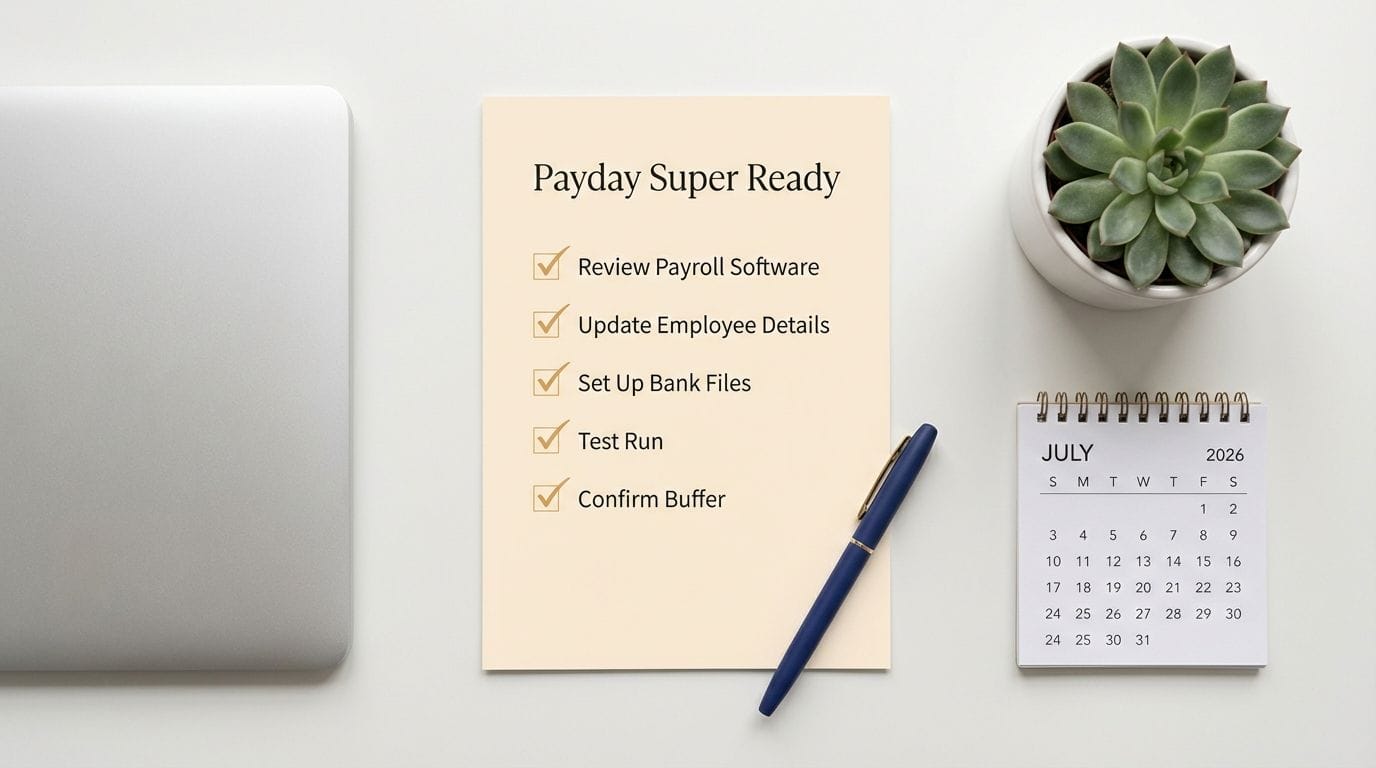
Already done the 30-minute action plan? This is the comprehensive version for those who want the full timeline.
Now Through March 2026
Check your systems:
- Can your payroll software do per-pay-cycle super? (Probably yes—check the settings)
- If using SBSCH, what’s your replacement? Decide now, not in May.
- Is your software provider releasing Payday Super updates? When?
Model the cash flow impact:
- Average pay run × 12% = your new per-cycle super outflow
- Update your forecasts to show super as a payroll cost, not quarterly
- If you’re seasonal, map out how payments fall during slow months
Clean up employee data:
- Are super fund details current? Wrong details = rejected payments = compliance problems
- Check TFNs and member numbers
- This is boring admin that saves real headaches later
April-May 2026
If using SBSCH:
- January-March should be your final SBSCH quarter
- Download your transaction history—you’ll lose access after June 30
- Store records securely
Set up your new system:
- Configure the alternative payment method
- Migrate employee fund details
- Set up approval workflows
- Run a test payment. Actually confirm it lands.
Update your processes:
- Brief anyone who touches payroll
- Document the new process
- Set up alerts for rejected contributions
June 2026
Final checks:
- Run a full test pay cycle including super
- Verify STP is reporting both QE and super liability
- Confirm your software is updated
Cash flow prep:
- Ensure funds are available for wages + super from 1 July
- Build a small buffer if things are tight
- Chase outstanding invoices if needed
From 1 July 2026
Make it routine:
- Super is now part of every pay run—treat it that way
- Monitor that contributions land within 7 days
- Monthly reconciliation catches problems early
Stay current:
- Review your process after the first month
- Watch for ATO guidance updates
- Fix issues quickly to stay low-risk
How Hopkan Partners Can Help

Regulatory changes while you’re running a business are annoying. We help small business owners navigate this stuff so compliance doesn’t become a distraction.
What we can do:
Cash flow modelling: We’ll map your specific situation—payroll patterns, revenue cycles, seasonal swings—and show exactly what Payday Super means for your bank account. Not generic advice; tailored forecasts. Learn more about our Virtual CFO services.
Systems review: Not sure if your setup will handle the transition? We’ll check your payroll software, super payments, and STP reporting. Find the gaps before they become problems.
Transition planning: If you’re on SBSCH or need to upgrade systems, we’ll help you evaluate options, manage the switch, and make sure nothing falls through the cracks.
Ongoing support: From July 2026, super is part of every pay run. We help clients build efficient processes that meet obligations without creating admin overhead.
This is what genuine financial partnership looks like—not just processing transactions, but helping you navigate changes with confidence.
Ready to Get Payday Super-Ready?
A quick conversation now saves stress later. Get in touch.
Disclaimer: This article provides general information only and does not constitute financial, legal, or tax advice. The information is current as at March 2026. For advice specific to your circumstances, please consult a qualified professional.