

James ran a plumbing supply business in Western Sydney. Revenue was $2.9 million. The P&L looked fine, margins were holding, overheads were steady, and he’d just landed his biggest wholesale client yet.
He didn’t look at his balance sheet. Not properly, anyway.
Over four months, his debtors climbed from $180,000 to $310,000. His cash balance barely moved. His current ratio slipped from 1.7 to 0.9. And every month, he drew his usual $18,000 from the business, because the P&L said he could afford it.
The call from his bank came on a Tuesday morning. His overdraft facility was under review. The covenant required a current ratio above 1.0. He’d been below it for six weeks.
James had 21 days to fix a problem that had been building for four months.
He didn’t have four months of warning in his P&L. He had it in his balance sheet, every single month. He just wasn’t looking at the right numbers.
Most business owners treat the balance sheet as the boring part, the page after the profit figure that the accountant sends and you scroll past. The reality is it’s the document that tells you what the profit and loss statement can’t: whether the business is actually healthy, or just looks healthy on paper.
This post is not a balance sheet tutorial. It’s a practical health check: the five numbers to look at, the three movements to watch month on month, and the warning signs worth acting on before your bank calls you first.
What Is a Balance Sheet? The 60-Second Version
A balance sheet is a snapshot of your business’s financial position on a specific date. It shows three things: what the business owns (assets), what it owes (liabilities), and what’s left over for you as the owner (equity).
The fundamental equation is: Assets = Liabilities + Equity. The two sides must always balance. That’s not an accounting rule, it’s a mathematical identity. If they don’t, something has been recorded incorrectly.
Think of the P&L as your scoreboard for the month. The balance sheet is the full picture of where the business stands right now. You need both to manage well, and the balance sheet is the one most owners look at last, if at all.
The balance sheet itself isn’t complicated. Not complicated at all. What trips most business owners up is knowing which numbers inside it actually matter and what it means when those numbers start moving in the wrong direction.
The 5 Numbers to Check Every Month
You don’t need to understand every line on your balance sheet. You need five numbers. Pull your balance sheet at the end of each month and run through these. It takes less than 15 minutes once you know what you’re looking for.
1. Can You Pay Your Bills Right Now? (Current Ratio)
Formula: Current Assets ÷ Current Liabilities
Why does it matter so much? The current ratio tells you whether your business has enough short-term assets to cover its short-term debts. It’s the first number a lender checks, and it’s what determines whether your overdraft facility stays in place.
| Current Ratio | What It Means |
|---|---|
| ≥ 1.5 | Comfortable — you can cover short-term debts and absorb a slow month |
| 1.0 – 1.5 | Workable, but watch the trend — limited room for a revenue dip or large bill |
| < 1.0 | You’re relying on future revenue to pay current debts. Act now |
Australian banks typically require a current ratio above 1.0 for overdraft facilities, and prefer 1.2 or above for working capital lending. James’s facility had a covenant set at 1.0. When his ratio slipped to 0.9, the bank called.
(Worth knowing: the ratio can look fine at month-end and deteriorate quickly mid-month if a large payment run hits. The trend over three months tells you more than any single snapshot.)
2. How Long Are Customers Actually Taking to Pay? (Debtor Days)
Formula: (Accounts Receivable ÷ Annual Revenue) × 365
Debtor days, also called Days Sales Outstanding, tells you the average number of days between issuing an invoice and receiving payment. According to the Payment Times Reporting Regulator, the average time an Australian SME waits to receive payment from large business customers is 35.4 days, despite most invoicing on 30-day terms.
Most business owners focus on the debtor balance. That’s the wrong number to watch.
A $90,000 debtor balance on 30-day payment terms is fine. The same $90,000 on 72-day average collection means your customers are paying more than two months after invoice. Your cash position and your P&L are telling completely different stories, and the balance sheet is the only place you can see the gap.
Your debtor days should sit at or below your standard payment terms. If you invoice on 30-day terms and your debtor days are sitting at 55, someone isn’t paying on time.
3. Do You Have Enough Cash Buffer? (Working Capital)
Formula: Current Assets − Current Liabilities
Working capital is the cash available to run the business day to day. A positive figure means current assets exceed current liabilities, but positive isn’t the same as adequate. Adequate is the real question.
If your monthly expenses run at $600,000 and your working capital is $40,000, you have less than a week of buffer. Frame it in weeks of operating expenses covered, not a raw dollar figure.
Benchmark to aim for: at least 8 weeks of monthly expenses covered by working capital. Below 4 weeks, you’re one slow-paying client or unexpected cost away from a cash problem. Below 2 weeks, that problem has likely already arrived.
This is what lenders look at when a business applies for a line of credit: not whether working capital is positive, but whether it’s sufficient for the scale of the operation.
4. How Much Are You Relying on Borrowed Money? (Debt-to-Equity Ratio)
Formula: Total Liabilities ÷ Total Equity
How leveraged is the business, really? The debt-to-equity ratio shows how the business is funded: what proportion comes from debt versus the owner’s own equity. A lower number generally means a stronger financial position.
| Debt-to-Equity | What It Signals |
|---|---|
| < 1.5 | Conservative — primarily equity-funded, lower financial risk |
| 1.5 – 3.0 | Moderate — acceptable in most industries, watch the trend |
| > 3.0 | High — vulnerable to interest rate movements and revenue dips |
| Negative equity | Liabilities exceed assets — warrants immediate review |
Alarming? Sometimes. Negative equity sounds worse than it often is, but it always requires understanding. It can result from cumulative losses, excessive owner drawings, or a period of heavy debt-funded investment. Context matters. What doesn’t change: if you’re in negative equity, you need to understand exactly why.
Industry matters here too. A capital-intensive trade business will naturally carry more debt than a service business. Compare against your own prior periods first, then against industry norms.
5. Is the Business Worth More Than Last Month? (Equity Trend)
Most owners ignore this one. It’s arguably the most honest summary of business performance available.
Month on month, equity is Assets minus Liabilities. If it’s growing, the business is retaining profit and building value. If it’s shrinking, the business is losing money, the owner is drawing more than the business earns, or both.
A single month of declining equity is rarely a problem. Two months in a row warrants a look. Three consecutive months of declining equity is a structural signal — not a blip. Understand it before it compounds.
The P&L shows you the revenue and expense story. The equity trend shows you the outcome. When they’re not consistent with each other, something in the books needs investigating.
The 3 Movements to Watch Month on Month
Comparing this month to last month, and the month before that, is where the real intelligence sits. In my experience working across listed companies and businesses of all sizes, these three movements show up in the numbers well before anyone notices them in day-to-day operations.
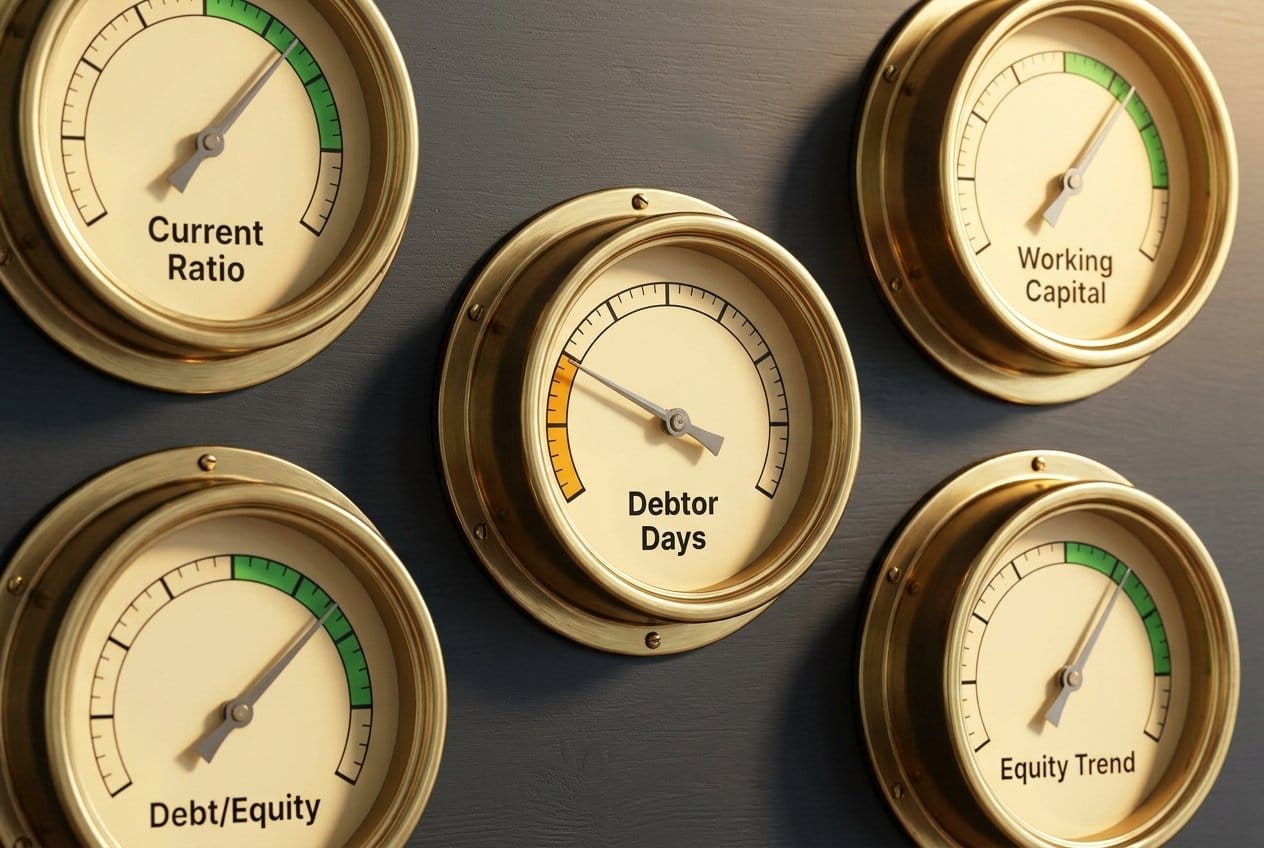
Are Your Debtors Rising While Cash Is Flat or Falling?
This is the single most common precursor to a cash crisis in Australian businesses. It’s almost always visible in the balance sheet 60 to 90 days before it becomes an emergency.
63% of Australian businesses are currently losing money to late payments. According to GoCardless’s 2025 Pursuing Payments report (conducted by YouGov across 500 Australian businesses), 1 in 6 SMBs are losing more than $2,500 per month (up from 11% the previous year). Nearly half (48%) say they’re waiting longer for payments than 12 months ago. That pressure shows up on your balance sheet first.

Here’s the pattern: revenue is growing or holding steady, debtors are climbing month on month, and cash isn’t moving, or is actually dropping. That combination tells you customers are taking longer to pay, invoices are accumulating, and the cash hasn’t arrived yet.
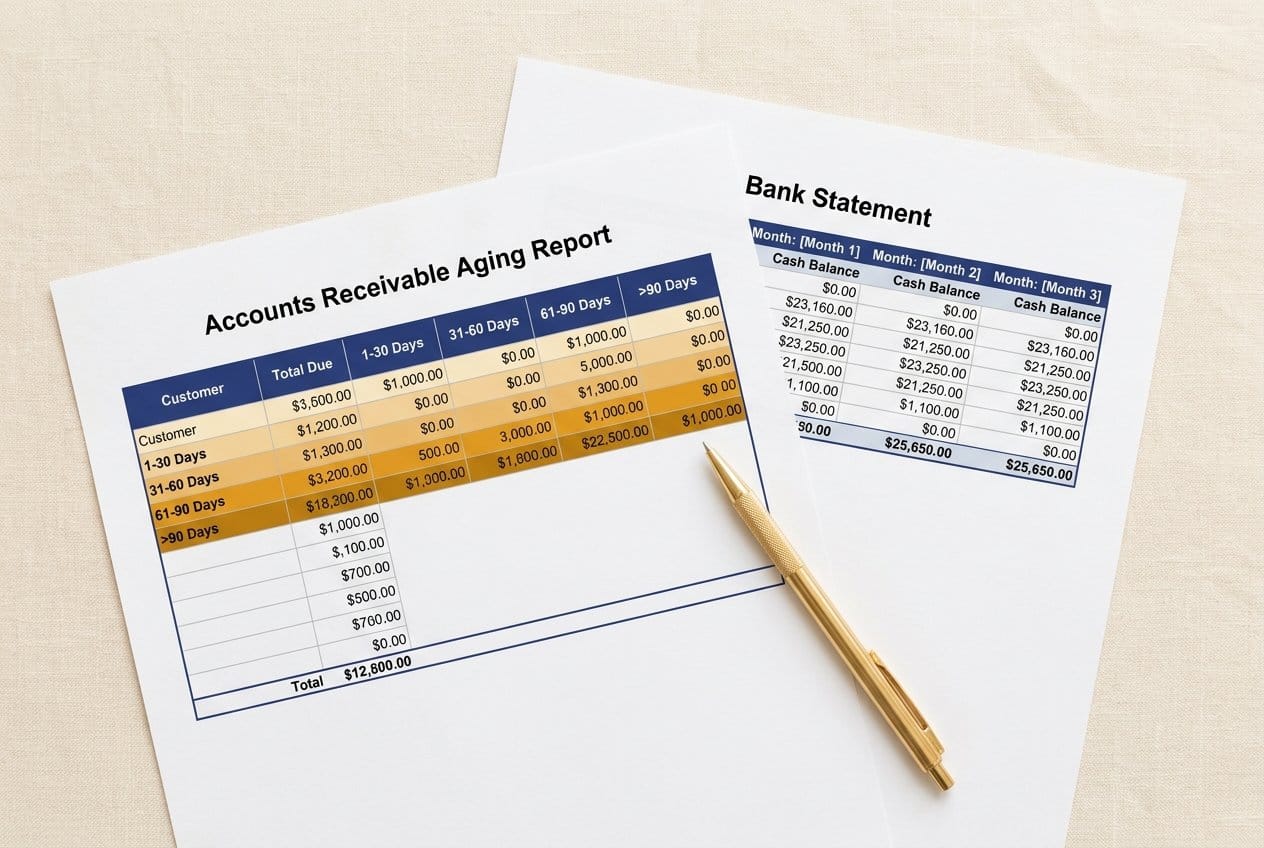
If debtors have grown two months in a row without a corresponding revenue increase, pull your aged receivables report immediately. Something specific is happening: a large client has slipped past their terms, payment follow-up has fallen behind, or credit has been extended to clients who aren’t paying. The balance sheet flags the problem. The aged receivables report tells you who is causing it.
This was James’s situation exactly. His new wholesale client was on 60-day terms (fine in isolation). But two long-standing clients had quietly drifted to 80 and 95 days. His debtors climbed $130,000 in four months while his cash sat still. His balance sheet showed it every single month. For more on how this plays out across your cash flow, see our guide to cash flow mistakes business owners make.
Are Liabilities Growing Faster Than Assets?
A growing liability position isn’t automatically a problem. A business taking on debt to fund equipment or expansion expects liabilities to rise. What matters is whether assets are growing at a similar pace.
When liabilities grow faster than assets over multiple months, the gap is typically being funded by operating cash. That’s a structure that compounds: the business borrows to cover shortfalls, interest costs increase, and the shortfall grows.
Short-term debt increasing while long-term debt stays flat is the specific signal to watch. That pattern often means the business is rolling operational gaps with short-term credit: bridging loans, invoice finance, or an expanding overdraft. It’s not always wrong, but it warrants a conversation about whether the underlying cause is being addressed or just deferred.
One thing worth flagging here: super payable appearing in your current liabilities means it hasn’t been paid yet. From 1 July 2026, under payday super rules, super must clear within 7 days of each pay run. A growing super payable balance is a liability that now has a much shorter fuse than it used to.
Is Inventory Building Without Revenue Growth? (Product Businesses)
This one only applies if your business holds stock, but for those that do, it’s worth checking monthly.
Inventory on the balance sheet represents cash that has already been spent. When inventory grows without a corresponding increase in revenue, cash is being converted into stock that isn’t moving. It won’t show on your P&L until you sell it, or write it down. (That write-down, when it eventually comes, is always a surprise to owners who weren’t watching the inventory line monthly.)
Of the five numbers in this post, inventory matters least if you run a service business. Skip it entirely if you don’t hold stock.
Worth watching specifically: inventory up more than 10–15% over two months while revenue is flat. That means purchasing is running ahead of sales velocity. Either the buying decisions need review, or there’s a sales problem that hasn’t surfaced yet.
Not sure what your balance sheet is telling you?
This is exactly what we review with clients every month: not just whether the numbers look right, but whether the movements make sense and what they mean for the business going forward. If you’d like a second set of eyes on your financials, book a free 30-minute call.
Red Flags vs Healthy Signs: Your Monthly Quick Reference
Use these two tables as your end-of-month checklist. Check the ratios first, then look at the movements. The “Act Now” column gives you the immediate next step, not just the diagnosis.
Ratios: Check These Numbers Right Now
| Check | Healthy | Watch | Act Now |
|---|---|---|---|
| Can you pay your bills? (Current Ratio) | ≥ 1.5 | 1.0 – 1.5 | < 1.0 → Review all payments due in the next 60 days |
| How fast are customers paying? (Debtor Days) | Within your payment terms | Up to 15 days over terms | > 15 days over → Pull your aged receivables report today |
| Do you have a cash buffer? (Working Capital) | 8+ weeks of expenses | 4 – 8 weeks | < 4 weeks → Pause non-essential spend immediately |
| How much debt vs equity? (Debt-to-Equity) | < 1.5 | 1.5 – 3.0 | > 3.0 or negative → Speak to your accountant this week |
| Is the business building value? (Equity Trend) | Growing month on month | Flat | Shrinking 2+ months → Review drawings and margin |
Movements: Watch These Month on Month
| What to Watch | Fine | Investigate | Act Now |
|---|---|---|---|
| Debtors vs cash | Both moving together | Debtors up, cash steady | Debtors up, cash flat or falling → Collections review |
| Liabilities trend | Growing in line with assets | Growing slightly faster | Outpacing assets 2+ months → Debt structure review |
| Equity direction | Growing | Flat | Falling 2+ consecutive months → P&L and drawings review |
| Inventory (product businesses) | In line with revenue | Slight build above trend | Rising with flat revenue → Purchasing and sales review |
A note on context: these benchmarks aren’t universal rules. Industry, growth stage, and seasonality all affect what’s normal for your business. A business in rapid expansion will look different to one in steady state. Use these as triggers for a conversation, not a verdict.
What Does This Look Like in Practice?
Karen runs an electrical parts wholesaling business in Brisbane, turning over $3.2 million a year. Her P&L looks strong, revenue up 14% year on year, gross margin holding at 31%.
But her balance sheet over three months tells a different story.
Her debtors climbed $68,000 over 90 days. Inventory grew $44,000 above her usual run rate. Her current ratio slipped from 1.6 to 1.1. She drew $30,000 more than usual across the quarter, because the P&L said she could afford it. Her equity dropped $22,000.
When she applied to refinance a vehicle loan for a new delivery van, the bank flagged concerns about her liquidity position and asked for three months of balance sheets. None of what they found was news — to them. It was news to Karen.
Debtors movement, month one. By month two, the current ratio had slipped. The equity decline was confirmed in month three.
The fix wasn’t complicated: tighten collections on two slow-paying clients (recovered $41,000 in 45 days), pause one large inventory order, and hold drawings at a set amount for the quarter. Three months later, her current ratio was back at 1.4 and the loan was approved.
Karen’s balance sheet didn’t predict the problem. It reported it — in real time, every month. She just hadn’t been reading it.
How Often Should You Run This Check?

Monthly is right for any business above $500,000 in annual turnover. Quarterly is the minimum, though quarterly reviews often catch problems too late to course-correct without pain.
According to ASIC’s insolvency statistics, inadequate cash flow or high cash use is cited as the cause of failure in 52% of Australian business insolvencies. Almost none of those businesses saw it coming in their P&L. Most had warnings in their balance sheet that went unread.
Run this check any time you’re making a significant financial decision: taking on debt, signing a lease, hiring a new employee, purchasing equipment. You want to know your current ratio, working capital position, and equity trend before you add to your liability structure. Not after.
Fifteen minutes. That’s all the monthly review takes once you know the five numbers and the three movements. A reasonable investment for what amounts to an early warning system that the P&L alone simply doesn’t provide.
The balance sheet James ignored for four months wasn’t hiding anything. It was showing him everything: the debtors climbing, the current ratio falling, the working capital shrinking. The numbers were there every single month. He just didn’t know which ones to look at.
You now do. Pull your balance sheet at the end of this month. Check the five numbers. Look at how they’ve moved. If something doesn’t look right, act on it. A problem that’s visible in the balance sheet today is a 21-day emergency in four months.
Want to know what your balance sheet is actually saying about your business?
Hopkan Partners reviews your financials monthly and translates the numbers into plain-English decisions. Book a free 30-minute call, no jargon, no obligation.